
67% of organizations say the talent and skills gap is their biggest AI challenge (KPMG AI in Business 2024, 2024). The constraint isn't budget or ambition — it's having the right people, in the right roles, available when the work requires them.
Resource planning for AI teams is harder than for standard software teams because the work requires a wider range of skills (data engineering, ML engineering, domain expertise, DevOps) that rarely exist in one person, the ratio of exploration to execution shifts unpredictably mid-project, and the market for skilled ML engineers remains far tighter than for general software roles.
This guide covers how to staff AI projects correctly from the start, plan capacity across multiple simultaneous engagements, and make the hire vs. contract decision without waiting until you're understaffed.
how we structure AI project delivery
Key Takeaways
- 67% of organizations cite talent gaps as their top AI challenge (KPMG, 2024) — yet most AI teams are understaffed in data engineering relative to ML engineering
- Most AI projects need four roles: data engineer, ML engineer, backend integrator, and a PM/tech lead — not all at 100% simultaneously
- Capacity planning for AI work requires tracking phase utilisation, not just headcount — the same engineer has 10x variance between a data audit sprint and a model deployment sprint
- Hire for the roles you'll use consistently for 12+ months; contract for specialised skills you'll use for one or two engagements
What Roles Does a Typical AI Project Actually Need?
AI projects fail due to insufficient resourcing more often than insufficient technology — and the staffing gap is typically in data engineering, not model development (Deloitte State of AI in the Enterprise 2024, 2024). The bias is understandable: ML engineering is the visible, headline skill. But the data work that makes ML possible often accounts for more project hours.
A well-staffed AI project typically requires four functional roles — not necessarily four people:
Data Engineer
When they're needed: Weeks 1–5 (highest load), then episodically for pipeline maintenance.
What they do: Builds and maintains the data pipelines that feed the model — extraction, cleaning, validation, schema normalisation, and storage. In most engagements, data engineering is underestimated by 40–60% at scoping time because clients overstate data quality.
Where teams go wrong: Assigning this work to the ML engineer. A senior ML engineer doing data cleaning is expensive, slow, and demoralising. Keep these roles separate.
ML Engineer
When they're needed: Weeks 3–8 (model development), with lower utilisation during data and integration phases.
What they do: Model architecture, training pipelines, evaluation frameworks, hyperparameter tuning, model registries, and inference optimisation. In LLM-based projects, this role also covers fine-tuning, RAG retrieval quality, and prompt pipeline development.
Backend / Integration Engineer
When they're needed: Weeks 6–10 (integration phase), with earlier involvement for API specification.
What they do: Connects the AI system to the client's existing infrastructure — API endpoints, authentication, logging, monitoring, and deployment pipelines. Often the most underestimated role because "it's just wiring it up" is never just wiring it up.
Tech Lead / Engineering Manager
When they're needed: Full engagement, typically at 30–50% allocation.
What they do: Owns delivery — estimation, client communication, scope control, sprint planning, and team unblocking. On smaller engagements, this role is held by a senior engineer who codes and manages. On larger engagements, it should be a dedicated role.
On our air-gapped EKS deployment, the original staffing plan was two engineers — one focused on infrastructure, one on application deployment. We added a third engineer in week two specifically for CI/CD pipeline work once it became clear the self-hosted runner setup was a full workstream in itself. Catching this at week two was recoverable. Catching it at week five would have missed the deadline.
See the air-gapped EKS deployment case study
How Do You Plan Capacity for AI Work That's Inherently Unpredictable?
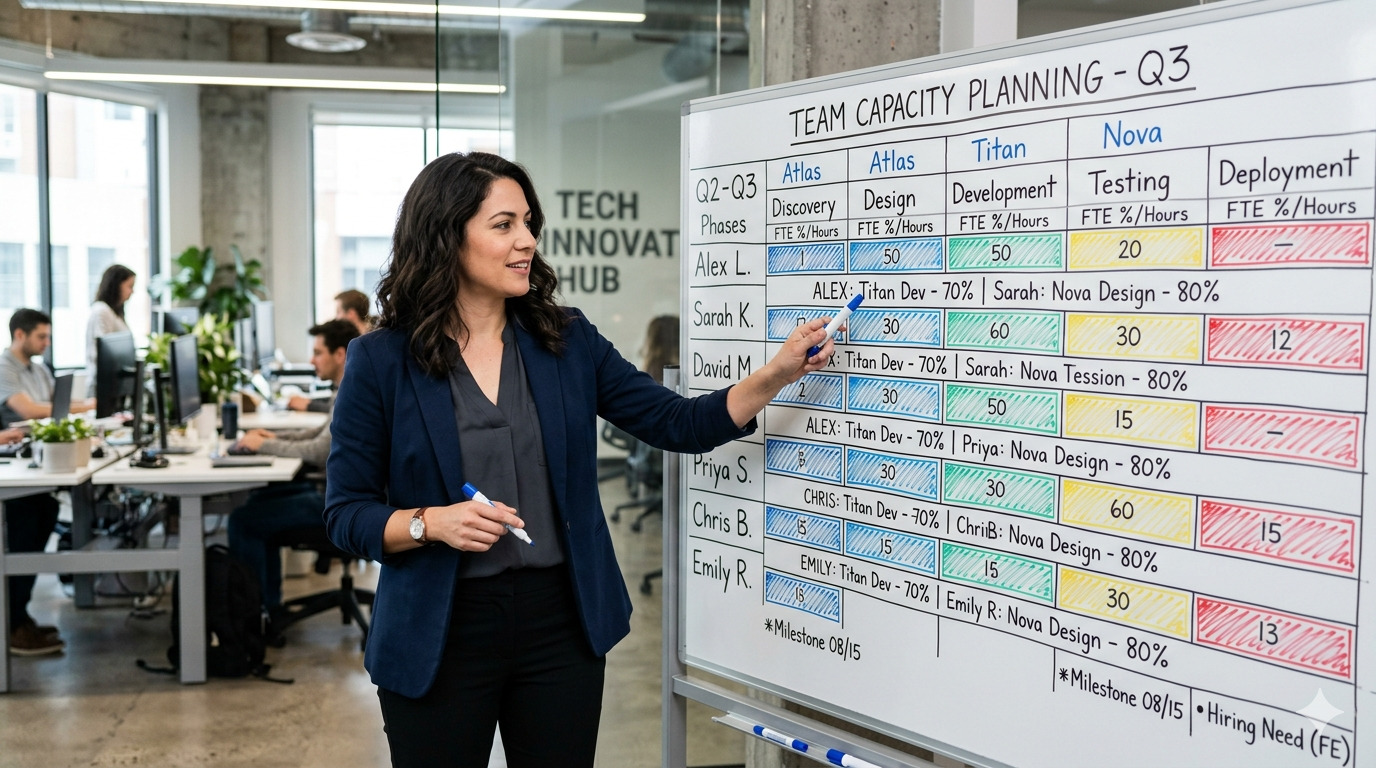
Planning AI team capacity at the project level is not enough. You need phase-level capacity planning because utilisation varies dramatically by phase — a data engineer at 100% during the pipeline build phase drops to 20% during model training (PMI Pulse of the Profession, 2024).
Phase-Level Utilisation Model
| Phase | Data Engineer | ML Engineer | Backend Engineer | Tech Lead |
|---|---|---|---|---|
| Discovery | 50% | 20% | 10% | 80% |
| Data Pipeline | 100% | 20% | 0% | 50% |
| Model Development | 30% | 100% | 20% | 50% |
| Integration | 20% | 40% | 100% | 50% |
| Deployment & Handoff | 10% | 30% | 80% | 70% |
This model tells you two things: (1) when each role's utilisation peaks, and (2) when there's spare capacity you can redirect to another engagement or use for technical debt work.
Multi-Engagement Capacity Planning
For AI consulting firms running multiple simultaneous engagements, phase staggering is the primary lever for capacity management. Two engagements both in their data pipeline phase simultaneously will over-utilise your data engineers. Two engagements offset by four weeks will balance smoothly.
The 70% rule: Never plan any engineer at more than 70% utilisation across active billable engagements. The remaining 30% absorbs estimation errors, internal work, client calls, and the inevitable "quick question" that isn't quick.
Flag phase overlaps at project intake. When a new engagement is being scoped, map its phase schedule against existing engagements. If two projects will hit data pipeline phases in the same four-week window, either delay the start of the new engagement or budget for a contractor to absorb the overflow.
The most expensive resourcing mistake in consulting isn't understaffing a single project — it's under-planning phase overlaps across the portfolio. We've seen teams that look well-staffed on paper hit a three-week window where every engineer is simultaneously in their highest-utilisation phase across different projects. The solution isn't more engineers — it's staggered project starts.
How Do You Staff AI Teams Across Multiple Simultaneous Engagements?
AI consulting firms typically run three to six active engagements simultaneously, with overlapping phases and shared team members across projects. This creates a resourcing model that's closer to a professional services firm than a product team — and it requires different planning tools (McKinsey Global Survey on AI 2024, 2024).
Assign owners, not teams. Every active engagement needs one named person who is accountable for delivery — the tech lead or PM. Without a named owner, client questions, blockers, and scope issues fall through the cracks between "team members" who assume someone else is handling it.
Protect deep work blocks. AI engineering tasks — model training, pipeline architecture, fine-tuning runs — require sustained focus. Context switching between three engagements in a single day destroys output quality. Where possible, batch similar-phase work: ML engineers focus on one project's model development before moving to another's. A useful rule: no more than two context switches per day per engineer.
Run a weekly portfolio standup, separate from project standups. The portfolio standup (15 minutes, tech leads only) covers: which engagements are on track, which have blockers, and whether any resourcing reallocation is needed. This prevents individual project standups from becoming the only forum for cross-engagement resource decisions — by which point it's usually too late to act smoothly.
When Should You Hire vs. Contract vs. Partner?
The hire/contract/partner decision is driven by how frequently you'll need the skill and how critical it is to your core delivery quality (LinkedIn Talent Intelligence 2024, 2024).
Hire For: Core Repeating Skills
Hire full-time for roles you'll use across every engagement for 12+ months. For an AI consulting firm, this typically means: ML engineers, data engineers, and a tech lead. These are the roles where institutional knowledge, client relationship continuity, and deep familiarity with your delivery process have compounding value.
Full-time ML engineering roles take an average of 36–45 days to fill in the current market (LinkedIn Talent Intelligence 2024, 2024) — longer than most other engineering roles. Start hiring 60 days before you need the person, not when the engagement is already underway.
Contract For: Specialised Skills You Need Once or Twice
Bring in contractors for skills required in one or two engagements but not consistently across your portfolio — specific ML frameworks, domain expertise (clinical data, financial modelling), or infrastructure specialisations (Kubernetes, cloud security). Contractors also absorb phase overlap peaks: when two engagements simultaneously hit their data pipeline phase, a short-term data engineering contractor is faster and cheaper than carrying a full-time hire in anticipation of peaks.
Partner For: Capabilities Adjacent to Your Core
For AI consulting firms, partnership makes sense for: UX/UI (if you build client-facing products), legal/compliance (for regulated industry clients), and specialised ML research (if a client engagement requires capabilities genuinely outside your team's depth). Partners provide credentialed expertise without the overhead of a full-time hire in a skill set you use occasionally.
How Do You Retain AI Talent in a Competitive Market?
AI engineers are among the most actively recruited employees in any industry — ML engineers receive an average of 10+ recruiter contacts per month (LinkedIn Talent Intelligence 2024, 2024). Retention in consulting is harder than in product companies because the work varies more, growth paths are less structured, and engineers may feel they'd rather work on one big AI product than cycle through multiple client projects.
Three factors drive AI engineer retention in a consulting context:
Technical challenge variety. The biggest advantage of consulting over product work is breadth — working on five different ML problems per year versus iterating on one. Make this explicit in the role. Engineers who want depth in a single domain will churn. Engineers who value variety and rapid skill-building will stay longer in consulting than product.
Investment in learning. AI is moving fast enough that engineers who aren't learning feel stale within 18 months. Budget for conference attendance, research paper time, and experimentation with new tools on non-billable time. This isn't a perk — it keeps your delivery capabilities current and signals that you're investing in the engineer's career, not just billing their hours.
Clear ownership. Engineers who feel accountable for outcomes — not just tasks — are more engaged and more likely to stay. Give engineers named ownership of deliverables, not just tickets. "You own the data pipeline for this engagement" creates more engagement than "complete these five tasks by Friday."
Build the Team Before You Need It
Resource planning in AI consulting has a long lead time. Senior ML engineers take 6–8 weeks to hire. Contractor relationships take time to develop before you can trust them with client work. Identifying phase overlap risks requires seeing your project pipeline at least 8 weeks forward.
The teams that resource well aren't the ones who respond fastest when they're understaffed. They're the ones who plan forward far enough that being understaffed is rare.
how we structure and deliver AI consulting engagements
Prodinit is an AI consulting and development firm. We've built production AI systems across healthcare, fintech, and B2B SaaS — with teams sized right for the work rather than staffed for appearances. Book a call if you're planning a build and want to talk through team structure before you start.
Frequently Asked Questions
Most focused AI engagements (8–12 weeks) are delivered by 2–3 engineers: a data/ML engineer who handles both pipeline and model work, a backend engineer for integration, and a tech lead at 30–50% allocation. Larger engagements (12–20 weeks, multiple AI components) typically run 3–5 engineers with more distinct role separation.
Two people at absolute minimum: one engineer focused on data and model work, one focused on integration and deployment. Below two, the cognitive load of simultaneously maintaining the data pipeline, model performance, and client communication degrades quality and increases delivery risk. Solo AI consulting engagements are viable only for very tightly scoped, well-defined work.
Not as the primary client-facing tech lead. Junior engineers can do excellent execution work — data pipeline building, model training, integration — but client communication, scope management, and estimation require pattern recognition from past engagements. A junior engineer leading delivery without senior oversight is the primary source of scope misalignment and missed deadlines in consulting firms.
First, maintain documentation and code review practices that make any engineer's work transferable — commented code, a daily or weekly engineering log, and modular architecture. Second, carry contractor relationships before you need them so you can bring in a replacement within days, not weeks. Third, disclose to the client immediately if the departure will affect timeline — they'll hear about it eventually, and early disclosure preserves trust.
A high-performing five-person AI consulting team: two ML/data engineers (one senior, one mid), one backend/DevOps engineer, one full-stack engineer for client-facing components, and one tech lead who codes at 50% and manages at 50%. This team can run two simultaneous engagements comfortably, with phase staggering to manage peak utilisation.